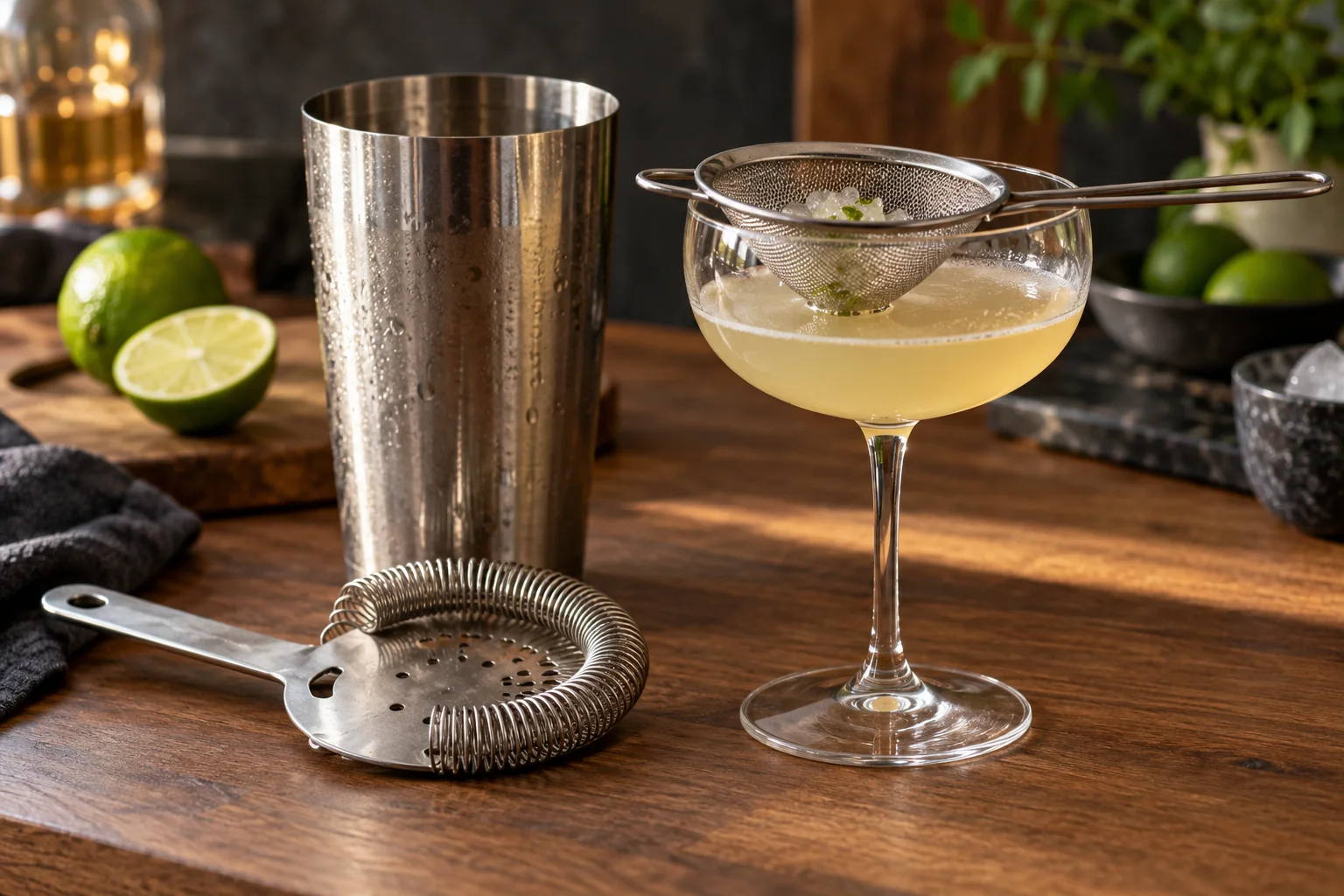
Your cocktail tastes balanced, but the first sip comes with a shard of ice or a strand of ginger. Before changing the recipe, look at the final pour. Double straining means pouring a cocktail through the shaker's main strainer and a separate fine-mesh sieve into the serving glass. The first holds back the large ice; the second catches smaller pieces.
Also called fine straining, this technique is useful when you want a drink without loose pulp, seeds, or herb fragments. It is a finishing choice, not a requirement for every cocktail. Here is how to decide when to use it, how to pour cleanly, and which tools matter.
How to double strain a cocktail
You need a prepared shaken cocktail, a chilled serving glass, a shaker strainer, and a small fine-mesh sieve. Diageo Bar Academy's strainer guide describes the second sieve as an optional step for a smoother finish. The setup below is a practical way to use that arrangement at home.
- Prepare the glass first. Chill it before mixing. Empty any chilling ice and water before you pour; add fresh serving ice if the recipe calls for it.
- Fit the primary strainer. With a Boston shaker, seat a Hawthorne strainer securely in the open tin. Keep a finger on it while pouring. With a three-piece cobbler shaker, use its built-in strainer.
- Position the fine sieve. Hold it by the handle just above the center of the glass. Keep its bottom above the drink's eventual surface, with enough room for liquid to drain freely.
- Pour in a controlled stream. Tilt the shaker so the liquid passes through the primary strainer, then into the middle of the mesh. Slow down if liquid pools in the sieve.
- Finish and serve. Let the last liquid drain briefly, then move the sieve to a small bowl or sink. Garnish and serve promptly. Avoid pressing trapped solids through the mesh.
Practice the movement with water and ice before making a drink. Set the glass on the counter, leave yourself room for both hands, and check that your strainer fits the tin before tilting it.
Hawthorne strainer versus fine-mesh strainer
These tools do different jobs. The Hawthorne strainer has a metal plate and a coiled spring that helps hold back ice at the mouth of a shaker. The fine-mesh strainer is the small sieve held over the glass to catch particles that pass the first barrier. Double straining uses both in one continuous pour; it does not mean pouring the finished drink back through the same tool twice.
A cobbler shaker already supplies the first barrier, so you may only need a small sieve. A julep strainer is commonly paired with a mixing glass for stirred drinks. Do not buy a second complete shaker set just to add a fine-straining step.
When double straining is worth doing
Start with drinks that contain visible material you do not want in the glass:
- Fresh ginger: our Penicillin recipe uses ginger slices, making it a useful example of why a second strainer helps.
- Berries or pulpy fruit: a Clover Club made with a seedy raspberry preparation benefits from catching the fragments before serving.
- Citrus drinks served without ice: try it with a Paper Plane when you want a surface without floating ice flecks.
The choice is less clear when you are only removing tiny ice chips. Difford's Guide presents both sides of fine straining: a cleaner finish can be desirable, while bartender Kevin Armstrong argues that it can also alter the lively texture of a freshly shaken drink. Treat texture as a preference to compare, rather than assuming the extra tool always improves the cocktail.
When to skip it
A cleanly stirred Manhattan usually does not need the same treatment as a shaker full of fruit. If the primary strainer leaves the texture you want, another pass adds work without solving an obvious problem.
Built drinks are a different case. A Mojito is assembled and served with its own mint and ice; removing those components changes the presentation. Follow the drink's intended method rather than applying double straining automatically.
Fine straining is also not clarification. It catches particles, but it does not turn cloudy citrus juice transparent or undo dilution already introduced by shaking. For a different process that changes clarity, see our milk punch guide.
Choosing tools for a cleaner pour
If you already own a shaker, check its straining arrangement first. A loose-fitting Hawthorne strainer can make pouring awkward even when the second sieve is excellent. Look for a secure fit with your tin, a comfortable finger rest, and a spring you can access for cleaning.
For the fine sieve, compare the basket width with your glass opening. A small, stable tool is easier to control than a large kitchen sieve balanced over a narrow coupe. Look for intact mesh, a firmly attached handle, and a basket that is easy to rinse. Follow the maker's cleaning instructions rather than assuming every finish is dishwasher-safe.
Affiliate disclosure: As an Amazon Associate I earn from qualifying purchases. If you buy through the paid link below, we may earn a commission at no extra cost to you. Read our affiliate policy.
Need the primary strainer for a Boston shaker? Compare Hawthorne cocktail strainers on Amazon.com (paid link). This opens a category search, not an individually tested product recommendation. Check the dimensions, current product details, and delivery options before choosing. A Hawthorne strainer alone does not replace the separate fine sieve.
Our bar tools guide explains the rest of a compact home setup. The hero image here is an AI-generated illustration of generic tools, not a photograph of a product offered through the link.
Fixing a slow or messy pour
The mesh fills faster than it drains. Reduce the pour rate. If pulp has blocked it, stop, empty and rinse the sieve, then continue. For your next drink, consider whether the fruit preparation needs straining before measuring it.
Liquid runs down the outside of the glass. Move the sieve toward the center and bring the shaker's stream closer to the basket. Try the positioning with water rather than adjusting over a finished cocktail.
Seeds or leaf pieces still get through. Inspect the mesh and the gap around its rim. A damaged sieve or a stream missing the basket will defeat the second straining step.
There is less foam than you expected. Avoid forcing the drink through clogged mesh. Compare your technique with our egg-white cocktail guide; fine straining cannot replace the shaking needed to build foam in the first place.
Rinse the sieve promptly after use so fruit and syrup do not dry into the mesh, then wash according to its care instructions. Check it before the next drink, especially when switching between recipes with different ingredients.
Frequently asked questions
Can I use a tea strainer?
An open, fine-mesh tea sieve can work if it is clean, fits above the glass, and drains freely. An enclosed tea infuser is awkward for this job. Try the sieve you already own with water before buying another tool.
Should every shaken cocktail be double strained?
No. Use it when it removes unwanted particles or gives you a texture you prefer. Compare one familiar recipe with and without the second sieve, keeping the ingredients and shaking method consistent.
Do I double strain before or after shaking?
After shaking, as you transfer the drink to its serving glass. Straining juice before mixing can remove pulp too, but it will not catch ice fragments created in the shaker.
Can a fine strainer fix an over-diluted drink?
No. It removes solids, not water already mixed into the cocktail. If a drink tastes thin, check measurements, ice condition, shaking, and how long it waited before serving.