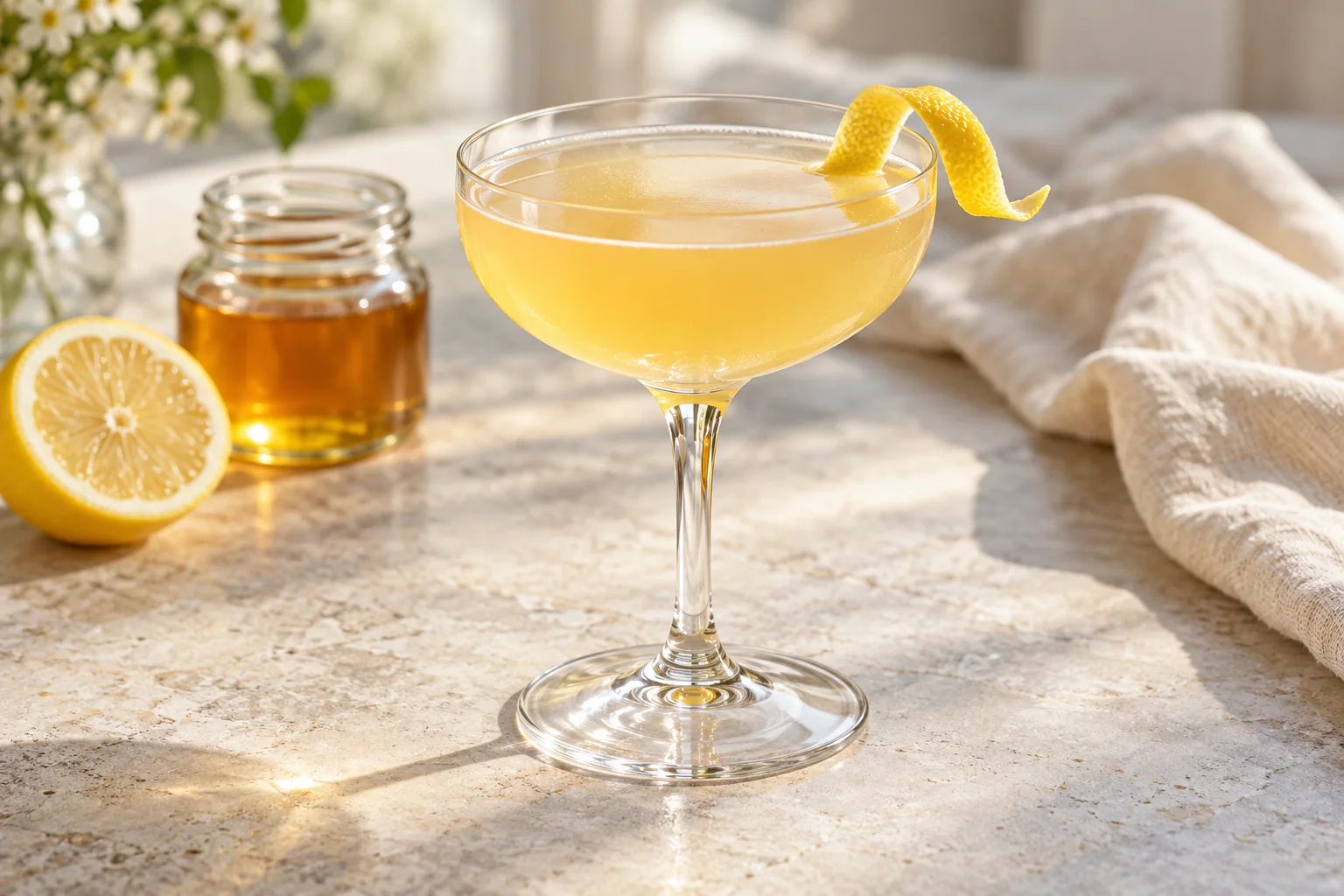
A Bee's Knees cocktail needs only gin, lemon juice and honey syrup. The lemon supplies a sharp edge; honey rounds it out and brings a flavor that ordinary sugar syrup cannot. Shaken and served in a chilled coupe, it is a compact gin sour with a pale golden appearance and a fragrant lemon finish.
The practical detail is the syrup: “honey syrup” can mean different concentrations. This recipe specifies a 2:1 honey-to-water syrup by volume, so you can make the drink consistently. No egg white, orange juice or elaborate garnish is needed for this three-ingredient version.
Bee's Knees Cocktail Recipe
Makes: 1 cocktail. Prep and total time: 5 minutes with cooled honey syrup ready. Glass: coupe or small cocktail glass. Measurements use a rounded bar conversion of 1 US fl oz to 30 ml; follow one unit system throughout. Allow extra time to make and cool the syrup if starting from scratch.
Ingredients
- 2 oz (60 ml) dry gin
- 3/4 oz (22.5 ml) freshly squeezed lemon juice
- 1/2 oz (15 ml) honey syrup, made with 2 parts honey to 1 part water by volume
- Ice, for shaking
- 1 lemon twist, for garnish
Instructions
- Chill the glass. Chill a coupe or small cocktail glass in the freezer, or fill it with ice water while preparing the drink.
- Measure the ingredients. Add the gin, lemon juice and cooled honey syrup to a cocktail shaker.
- Shake with ice. Fill the shaker generously with ice and shake hard for 10–15 seconds, until the outside feels very cold.
- Strain. Empty any ice water from the glass. Strain the cocktail through a cocktail strainer and a fine mesh sieve into the chilled glass, without serving ice.
- Finish with lemon. Hold the lemon twist over the drink and gently squeeze it to release the peel oils, then place it on the rim. Serve immediately.
Start with these proportions before adjusting. The result should have a clear lemon character with honey underneath it, rather than tasting like sweetened gin.
How to Make 2:1 Honey Syrup
Combine 2 oz (60 ml) honey with 1 oz (30 ml) warm water in a small heatproof container. Stir until smooth, then let it cool before measuring it into the shaker. Use the same measuring vessel for both ingredients: this ratio is by volume, not weight.
Barr Hill's honey cocktail recipes use this two-parts-honey-to-one-part-water approach. Our cocktail uses less syrup than Barr Hill's published Bee's Knees, for a drier starting point. SAQ's Bee's Knees recipe also specifies a 2:1 syrup with a half-ounce serving.
Raw honey can cling to the shaker as it cools, leaving sweetness behind instead of distributing it through the drink. Diluting it first makes it easier to pour and measure; Sipsmith explains the same practical reason for making honey syrup, although its recipe uses equal parts honey and water.
Label your syrup with its ratio and preparation date, then refrigerate it in a clean, covered container. Cool the syrup before using it: warm syrup makes the shaker do extra work and changes how quickly the ice melts.
Which Honey and Gin Should You Use?
Choose honey you enjoy tasting on its own. Mild clover honey is a useful starting point when you want the gin to remain easy to identify. Orange blossom honey is an appealing choice for a citrus-focused variation. Wildflower honey can vary noticeably between jars, so taste it before deciding how much syrup to add.
Dark, strongly flavored honey creates a more assertive drink. That can be interesting, but a jar with an earthy or bitter edge will carry those qualities into the glass. Try one serving before making a batch with an unfamiliar honey.
For gin, begin with a dry style rather than a sweetened gin liqueur. A juniper-led London dry gives the drink a defined botanical finish. A citrus-led dry gin can make the lemon feel more prominent.
You do not need honey-flavored gin. The syrup already provides that ingredient, and a sweetened spirit may require a different balance. For a longer gin-and-lemon drink served over ice, try a Tom Collins.
Getting the Shake and Sweetness Right
Use freshly squeezed lemon juice and measure it. Lemon size varies, so “half a lemon” is less reliable than a jigger.
A generous fill of ice gives you room to shake briskly and chill the drink. Fine-straining catches small ice chips and stray pulp, making the texture more uniform.
Taste a small sample after shaking. If it is too tart for your lemon and honey combination, add 1 teaspoon (5 ml) of the same honey syrup, then briefly shake again. If it feels too sweet, add 1 teaspoon (5 ml) lemon juice and repeat.
Keep the coupe cold and serve promptly. With no ice in the glass, the cocktail warms as it sits. A lemon twist adds aroma without introducing more juice, which is why it suits this small sour particularly well.
A Four-Serving Bee's Knees Batch
For four drinks, combine:
- 8 oz (240 ml) dry gin
- 3 oz (90 ml) fresh lemon juice
- 2 oz (60 ml) 2:1 honey syrup
This gives 13 oz (390 ml) of undiluted mix. Refrigerate the mixture in a covered container and gently stir before pouring. Measure 3 1/4 oz (97.5 ml) per cocktail, shake with ice and strain into a chilled glass. Garnish each serving with its own lemon twist.
Make the syrup ahead, but squeeze the lemons and assemble the mix close to serving. Shake one sample before committing to the full batch if you are trying a new honey. The mix still needs shaking: pouring it straight from the refrigerator skips the dilution and aeration of the single-serving method.
Does the Official Bee's Knees Include Orange Juice?
The International Bartenders Association's Bee's Knees includes 52.5 ml dry gin, 22.5 ml lemon juice, 22.5 ml orange juice and two teaspoons of honey syrup. That is a different specification from the three-ingredient gin, lemon and honey sour here.
Both approaches appear under the name. Follow one complete recipe rather than adding orange juice to this one and expecting the same balance. The IBA recipe is useful to explore if you want to compare a two-citrus version.
Frequently Asked Questions
Can I use 1:1 honey syrup?
Yes, but the same measure contains less honey. Begin with 3/4 oz (22.5 ml) of a syrup made from equal volumes honey and water in place of the 1/2 oz (15 ml) 2:1 syrup, then taste after shaking. Treat this as an adjustment, not an exact sweetness conversion.
Does a Bee's Knees need egg white?
No. The main recipe has no egg white and no dry shake. Shaking may leave a few bubbles on top, but a thick, lasting foam cap is not the intended finish. For a gin sour with raspberry and egg-white texture, see our Clover Club recipe.
What else can I make with honey syrup?
The Penicillin cocktail explores honey, lemon and ginger with Scotch. It uses a 1:1 honey syrup, so follow its syrup and ginger instructions rather than carrying over this recipe's richer syrup unchanged. If you would rather stay with gin and lemon while adding sparkling wine, a French 75 offers a different direction.